Strategy B — the 3-layer system
SOL is falling, yet Gus's SOL count is growing. Strategy B stacks three layers — lending, an LP and options — like a cake: one weaker layer, the other two still hold. You'll see what sits in each layer, whether the LP covers the costs, why a falling price turns the LP into SOL, and why you start with MINI.
Why Strategy B?
This lesson builds on what we learned in Modules 3-5: KaminoKaminoSolana lending protocol. In our strategy: SOL collateral to a USDC loan.Read the lesson →/AaveAaveEthereum lending protocol (v3). In our strategy: ETH collateral to a USDC loan.Read the lesson → lending, OrcaOrcaA Solana DEX with concentrated liquidity (Whirlpool). The basis of our LP strategy on the Solana network.Read the lesson →/UniswapUniswapAn Ethereum concentrated-liquidity protocol (V3/V4). Its Solana counterpart is Orca.Read the lesson → concentrated liquidity LPLPLiquidity Provider — deposits tokens into a pool and earns a share of trading fees.Read the lesson →, and DeribitDeribitA crypto options exchange. In our strategy this is where we buy put protection and sell covered calls.Read the lesson → options Put SpreadPut SpreadLong put + short put. Cheaper protection than a plain put, but with limited coverage.Read the lesson →. If any of these terms are unfamiliar, we recommend going back and reviewing the relevant module.
Strategy A has a problem: insurance costs sometimes exceed LPLPLiquidity Provider — deposits tokens into a pool and earns a share of trading fees.Read the lesson → earnings. Strategy B solves this by creating three independent profit layers. Each is optimized for its own function.
Think of it like having three different jobs:
- First job (lending) — stable, small pay. Like a government job
- Second job (LPLPLiquidity Provider — deposits tokens into a pool and earns a share of trading fees.Read the lesson → fees) — variable, but potentially high earnings. Like running a business
- Third job (options) — premiums and insurance. Like investing
Even if one job temporarily stops working — the other two still cover you.
Portfolio parameters
At the time of writing (2026-09) the market is around ~$102 — the figures are illustrative, and the mechanism does not depend on the price. Worth knowing: at the current price this example's LPLPLiquidity Provider — deposits tokens into a pool and earns a share of trading fees.Read the lesson → band ($64–$88) would be out of range, and in 2026-06 SOLSOLSolana's native token. Used to pay gas and as collateral.Read the lesson → fell all the way to $60 — below the lower bound. A real position would have to be moved.
| Parameter | Value |
|---|---|
| Assets | 126 SOLSOLSolana's native token. Used to pay gas and as collateral.Read the lesson → (~$11,088 at $88) |
| Net delta | +56.5 SOLSOLSolana's native token. Used to pay gas and as collateral.Read the lesson → (~45% dependent on price) |
| Daily Carry | ~$1.93 per day (6.4% per year, 126 SOLSOLSolana's native token. Used to pay gas and as collateral.Read the lesson → portfolio, $88 SOLSOLSolana's native token. Used to pay gas and as collateral.Read the lesson → price) |
| BreakevenBreakevenThe breakeven point — the price at which a position is neither profitable nor at a loss.Read the lesson → LPLPLiquidity Provider — deposits tokens into a pool and earns a share of trading fees.Read the lesson → | ~46% (currently: ~68% fee APRAPRAnnual Percentage Rate — the annual interest rate WITHOUT compounding. 10% APR = +10% per year.Read the lesson → = 1.48x coverage) |
Daily Carry (net daily earnings after all costs) is how much you earn per day from the whole strategy, after subtracting all costs. Like a daily wage. ~$1.93 per day (126 SOLSOLSolana's native token. Used to pay gas and as collateral.Read the lesson → portfolio, $88 SOLSOLSolana's native token. Used to pay gas and as collateral.Read the lesson → price) might not sound like much, but it is income that comes from time, not from the price going up.
Important: it is not constant. LPLPLiquidity Provider — deposits tokens into a pool and earns a share of trading fees.Read the lesson → fees stop accruing entirely once the price leaves your range — and they are the only positive term in this calculation. The insurance cost moves with IVIVImplied Volatility — the volatility the market expects. SOL IV is roughly 70-80%.Read the lesson →, and the debt interest moves with the KaminoKaminoSolana lending protocol. In our strategy: SOL collateral to a USDC loan.Read the lesson → rate. The annual figure (~$704) is an extrapolation of today's run rate, not a forecast and not a promise.
These figures depend on portfolio size, SOLSOLSolana's native token. Used to pay gas and as collateral.Read the lesson → price, and market conditions (a 2026-09 example). Actual results may vary.
Layer 1 — Lending (interest)
This lesson takes the SOL path: SOL KaminoKaminoSolana lending protocol. In our strategy: SOL collateral to a USDC loan.Read the lesson → collateral → Orca OrcaOrcaA Solana DEX with concentrated liquidity (Whirlpool). The basis of our LP strategy on the Solana network.Read the lesson → LPLPLiquidity Provider — deposits tokens into a pool and earns a share of trading fees.Read the lesson →. Everything on one chain.
The chains cannot be mixed. ETH AaveAaveEthereum lending protocol (v3). In our strategy: ETH collateral to a USDC loan.Read the lesson → runs on EthereumEthereumA blockchain with smart contracts. We use Aave (lending) and Uniswap (LP) on it.Read the lesson → and does not accept SOL as collateral, while OrcaOrcaA Solana DEX with concentrated liquidity (Whirlpool). The basis of our LP strategy on the Solana network.Read the lesson → does not exist on EthereumEthereumA blockchain with smart contracts. We use Aave (lending) and Uniswap (LP) on it.Read the lesson →. If you chose AaveAaveEthereum lending protocol (v3). In our strategy: ETH collateral to a USDC loan.Read the lesson →, your collateral would be ETH and your LPLPLiquidity Provider — deposits tokens into a pool and earns a share of trading fees.Read the lesson → would be UniswapUniswapAn Ethereum concentrated-liquidity protocol (V3/V4). Its Solana counterpart is Orca.Read the lesson → V3 ETH. That is an entirely separate branch with different numbers. Every figure below applies only to the SOLSOLSolana's native token. Used to pay gas and as collateral.Read the lesson →/SolanaSolanaA fast blockchain (under 1s, gas under $0.01). Home to the Kamino, Orca and Meteora ecosystem.Read the lesson → path.
Why USDC? USDCUSDCA USD stablecoin issued by Circle. Regulated, audited monthly. Our primary stablecoin and loan asset in the Kamino/Aave strategies.Read the lesson → is the largest regulated stablecoin (Circle), with the highest liquidity on the SolanaSolanaA fast blockchain (under 1s, gas under $0.01). Home to the Kamino, Orca and Meteora ecosystem.Read the lesson → network — during a crisis the debt is easy to repay quickly, and smart contract risk is low. USDCUSDCA USD stablecoin issued by Circle. Regulated, audited monthly. Our primary stablecoin and loan asset in the Kamino/Aave strategies.Read the lesson → earns nothing by itself, so the cost of debt = the full KaminoKaminoSolana lending protocol. In our strategy: SOL collateral to a USDC loan.Read the lesson → USDCUSDCA USD stablecoin issued by Circle. Regulated, audited monthly. Our primary stablecoin and loan asset in the Kamino/Aave strategies.Read the lesson → rate (~6%, 2026-09; variable) — LPLPLiquidity Provider — deposits tokens into a pool and earns a share of trading fees.Read the lesson → fees have to cover it.
Layer 2 — Concentrated Liquidity (LP fees)
| Parameter | Value |
|---|---|
| Type | Single-sided USDCUSDCA USD stablecoin issued by Circle. Regulated, audited monthly. Our primary stablecoin and loan asset in the Kamino/Aave strategies.Read the lesson → position |
| RangeRangeThe price range of a concentrated LP position. Fees only accrue while the price is inside the range.Read the lesson → | -28% below current price |
| Example (SOLSOLSolana's native token. Used to pay gas and as collateral.Read the lesson →@$88) | $64 — $88 |
| Capital | ~3,200 USDCUSDCA USD stablecoin issued by Circle. Regulated, audited monthly. Our primary stablecoin and loan asset in the Kamino/Aave strategies.Read the lesson → |
| YieldYieldReturn, income. In DeFi, yield comes from LP fees, lending interest, and staking rewards. | ~68% per year (instantaneous fee APRAPRAnnual Percentage Rate — the annual interest rate WITHOUT compounding. 10% APR = +10% per year.Read the lesson →, variable) |
| Fees per day | ~$5.95 |
How does single-sided LP work?
- Price above the range ($88+): the whole position is USDCUSDCA USD stablecoin issued by Circle. Regulated, audited monthly. Our primary stablecoin and loan asset in the Kamino/Aave strategies.Read the lesson →. You earn fees whenever people swap SOLSOLSolana's native token. Used to pay gas and as collateral.Read the lesson → into USDCUSDCA USD stablecoin issued by Circle. Regulated, audited monthly. Our primary stablecoin and loan asset in the Kamino/Aave strategies.Read the lesson →
- Price inside the range ($64-$88): part of the USDCUSDCA USD stablecoin issued by Circle. Regulated, audited monthly. Our primary stablecoin and loan asset in the Kamino/Aave strategies.Read the lesson → becomes SOLSOLSolana's native token. Used to pay gas and as collateral.Read the lesson →. You earn fees from both sides
- Price below the range (<$64): everything has become SOLSOLSolana's native token. Used to pay gas and as collateral.Read the lesson →. Fees stop generating — the position is "dormant"
An LPLPLiquidity Provider — deposits tokens into a pool and earns a share of trading fees.Read the lesson → position is like an insurance company. You earn every day from fees (like an insurance company earns from premiums). But if the price moves sharply, you incur a loss from impermanent loss (a temporary loss caused by the price difference between LPLPLiquidity Provider — deposits tokens into a pool and earns a share of trading fees.Read the lesson → entry and now), like an insurance company paying out claims. That's why LPLPLiquidity Provider — deposits tokens into a pool and earns a share of trading fees.Read the lesson → and options together make a good team.
Layer 3 — Options (Deribit)
| Position | Strike | Size | Delta | Theta/d | Purpose |
|---|---|---|---|---|---|
| Long Put | $90 | 200 SOLSOLSolana's native token. Used to pay gas and as collateral.Read the lesson → | -0.42 | -$3.25 | Core protection |
| Short Put | $65 | 100 SOLSOLSolana's native token. Used to pay gas and as collateral.Read the lesson → | +0.18 | +$1.50 | Reduces insurance cost |
| Short Put | $60 | 100 SOLSOLSolana's native token. Used to pay gas and as collateral.Read the lesson → | +0.12 | +$1.00 | Even more premium |
| Short Call | $160 | 50 SOLSOLSolana's native token. Used to pay gas and as collateral.Read the lesson → | -0.08 | +$0.75 | Additional income |
Options numbers
Net premium:      -$1,300 + $500 + $300 + $100 = -$400
Net theta/day:    -$3.25 + $1.50 + $1.00 + $0.75 = +$0.00
Net delta:        (-84) + 18 + 12 + (-4) = -58 SOL
                  (with adjustments: ~-81 SOL)
Add up all four positions and theta balances out to ~$0 per day — the three short options return as much as the long PutPutAn option type that grants the right to SELL at a set price. Used as insurance.Read the lesson → costs. Which means theta is not your daily cost.
The real cost is the net premium: −$400 over 120 days. In other words:
-$400 ÷ 120 days = ~-$3.33 per day
That is what the insurance actually costs per day. The tables below use the rounded −$3.25/d — a number that nearly coincides with the long PutPutAn option type that grants the right to SELL at a set price. Used as insurance.Read the lesson →'s theta, but means something different: it is the cost of insurance, not time decay.
Daily Carry — how much you earn every day
| Item | Per day | Per year |
|---|---|---|
| LPLPLiquidity Provider — deposits tokens into a pool and earns a share of trading fees.Read the lesson → Fees | +$5.95 | +$2,172 |
| Insurance cost (amortized net premium) | -$3.25 | -$1,186 |
| Debt interest (USDCUSDCA USD stablecoin issued by Circle. Regulated, audited monthly. Our primary stablecoin and loan asset in the Kamino/Aave strategies.Read the lesson → KaminoKaminoSolana lending protocol. In our strategy: SOL collateral to a USDC loan.Read the lesson →) | -$0.77 | -$282 |
| Net carry | ~$1.93 | ~$704 |
USDCUSDCA USD stablecoin issued by Circle. Regulated, audited monthly. Our primary stablecoin and loan asset in the Kamino/Aave strategies.Read the lesson → debt is charged the full KaminoKaminoSolana lending protocol. In our strategy: SOL collateral to a USDC loan.Read the lesson → rate (6%, 2026-09; variable): $4,704 × 6% / 365 ≈ $0.77 per day ($282 per year). A stablecoin earns nothing by itself, so this is the real cost of the debt — together with the insurance, LPLPLiquidity Provider — deposits tokens into a pool and earns a share of trading fees.Read the lesson → fees have to cover it (see breakeven below).
These figures depend on portfolio size, SOLSOLSolana's native token. Used to pay gas and as collateral.Read the lesson → price, and market conditions. Actual results may vary.
Net Delta and protection
Here are all the strategy's positions at a glance — like a scale:
This means:
- 55% of the portfolio is protected from a drop
- 45% remains dependent on price — you earn from growth
- This is a balance between safety and profit potential
+11.5 SOLSOLSolana's native token. Used to pay gas and as collateral.Read the lesson → only holds while the price is inside the range (roughly $80). At the upper bound ($88) the LPLPLiquidity Provider — deposits tokens into a pool and earns a share of trading fees.Read the lesson → position is 100% USDCUSDCA USD stablecoin issued by Circle. Regulated, audited monthly. Our primary stablecoin and loan asset in the Kamino/Aave strategies.Read the lesson →, so its delta is ~0 and net delta becomes 126 + 0 − 81 = +45 SOL. If the price falls to $64, the LPLPLiquidity Provider — deposits tokens into a pool and earns a share of trading fees.Read the lesson → turns into ~42.6 SOLSOLSolana's native token. Used to pay gas and as collateral.Read the lesson → and net delta rises to ~+88 SOLSOLSolana's native token. Used to pay gas and as collateral.Read the lesson →.
In other words: the deeper the price falls, the more exposed to SOL you become — which is exactly why the PutPutAn option type that grants the right to SELL at a set price. Used as insurance.Read the lesson → protection matters in a bear phase. Recheck this number whenever the price moves meaningfully.
Breakeven — how much LP needs to earn
For the strategy to be profitable, LPLPLiquidity Provider — deposits tokens into a pool and earns a share of trading fees.Read the lesson → has to earn enough to cover its costs:
Daily costs = Theta + Debt interest
            = $3.25 + $0.77
            = $4.02 per day

LP earns:      $5.95 per day
Coverage:      5.95 / 4.02 = 1.48x  (earning 48% more than needed)
| Metric | Value | Good? |
|---|---|---|
| Minimum LPLPLiquidity Provider — deposits tokens into a pool and earns a share of trading fees.Read the lesson → yield | ~46% per year | Below this — loss |
| Current LPLPLiquidity Provider — deposits tokens into a pool and earns a share of trading fees.Read the lesson → yield | ~68% per year (instantaneous) | Sufficient |
| Coverage | 1.48x | Healthy buffer |
What happens at different prices (over 120 days)
| Scenario | SOL price | Collateral | LP | Options | Carry | Total |
|---|---|---|---|---|---|---|
| -60% | $35.20 | -$6,653 | -$2,150 | +$4,800 | +$232 | -$3,771 |
| -30% | $61.60 | -$3,326 | -$800 | +$2,400 | +$232 | -$1,494 |
| -20% | $70.40 | -$2,218 | -$200 | +$1,400 | +$232 | -$786 |
| 0% | $88.00 | $0 | $0 | -$400 | +$232 | -$168 |
| +20% | $105.60 | +$2,218 | $0 | -$500 | +$232 | +$1,950 |
| +50% | $132.00 | +$5,544 | $0 | -$600 | +$232 | +$5,176 |
| +100% | $176.00 | +$11,088 | $0 | -$1,800 | +$232 | +$9,520 |
3 strategy variants — start from your own level
Strategy B isn't "all or nothing." There are 3 variants, each with a different level of complexity and income. Start with Mini, grow into Full.
🌱 MINI variant — Lending only (Layer 1)
| Parameter | Value |
|---|---|
| Layers | Layer 1 only (KaminoKaminoSolana lending protocol. In our strategy: SOL collateral to a USDC loan.Read the lesson → or AaveAaveEthereum lending protocol (v3). In our strategy: ETH collateral to a USDC loan.Read the lesson →) |
| Minimum amount | From $100 |
| Time per week | ~5 min |
| Complexity | ⭐ Easy |
| Expected APYAPYAnnual Percentage Yield — the annual interest rate WITH compounding. Always higher than the equivalent APR.Read the lesson → | ~5-7% |
| Daily CarryDaily CarryNet daily result: LP fees minus theta minus debt cost.Read the lesson → ($1k portfolio) | ~$0.16/d |
| Protection | LTVLTVLoan-to-Value — the ratio of debt to collateral value. LTV 30% is considered safe. LTV 83%+ triggers liquidation.Read the lesson → buffer only (30%) |
Who it suits: Beginners, small capital, wants to understand the collateral mechanism without complexity.
How to start:
- 1 SOLSOLSolana's native token. Used to pay gas and as collateral.Read the lesson → → KaminoKaminoSolana lending protocol. In our strategy: SOL collateral to a USDC loan.Read the lesson → as collateral
- BorrowBorrowTaking a loan in a DeFi protocol against deposited collateral.Read the lesson → at 30% LTVLTVLoan-to-Value — the ratio of debt to collateral value. LTV 30% is considered safe. LTV 83%+ triggers liquidation.Read the lesson → (e.g., 30 USDCUSDCA USD stablecoin issued by Circle. Regulated, audited monthly. Our primary stablecoin and loan asset in the Kamino/Aave strategies.Read the lesson → against 100 USD worth of SOLSOLSolana's native token. Used to pay gas and as collateral.Read the lesson →)
- Use the USDCUSDCA USD stablecoin issued by Circle. Regulated, audited monthly. Our primary stablecoin and loan asset in the Kamino/Aave strategies.Read the lesson → for something (another project, a purchase, or just hold it)
- Check LTVLTVLoan-to-Value — the ratio of debt to collateral value. LTV 30% is considered safe. LTV 83%+ triggers liquidation.Read the lesson → weekly — if it approaches 45%, repay debt
Drawback: Low yield (5% APYAPYAnnual Percentage Yield — the annual interest rate WITH compounding. Always higher than the equivalent APR.Read the lesson →). But it's the simplest way to understand DeFiDeFiDecentralized Finance — financial services without intermediaries, operating through smart contracts.Read the lesson → lending.
🌿 MEDIUM variant — Lending + LP (Layer 1+2)
Who it suits: After Mini, wants higher income, can spend time managing the range.
How to start:
- Start like Mini: SOLSOLSolana's native token. Used to pay gas and as collateral.Read the lesson → → KaminoKaminoSolana lending protocol. In our strategy: SOL collateral to a USDC loan.Read the lesson →, borrow USDCUSDCA USD stablecoin issued by Circle. Regulated, audited monthly. Our primary stablecoin and loan asset in the Kamino/Aave strategies.Read the lesson →
- Keep half the USDCUSDCA USD stablecoin issued by Circle. Regulated, audited monthly. Our primary stablecoin and loan asset in the Kamino/Aave strategies.Read the lesson → in a safe (for a crisis)
- PutPutAn option type that grants the right to SELL at a set price. Used as insurance.Read the lesson → the other half → OrcaOrcaA Solana DEX with concentrated liquidity (Whirlpool). The basis of our LP strategy on the Solana network.Read the lesson → single-sided LPLPLiquidity Provider — deposits tokens into a pool and earns a share of trading fees.Read the lesson → (-28% range)
- Monitor: LTVLTVLoan-to-Value — the ratio of debt to collateral value. LTV 30% is considered safe. LTV 83%+ triggers liquidation.Read the lesson → + LPLPLiquidity Provider — deposits tokens into a pool and earns a share of trading fees.Read the lesson → range + harvest fees weekly
- Reinvest fees into collateral (compound)
Drawback: No protection against a large drop. If SOLSOLSolana's native token. Used to pay gas and as collateral.Read the lesson → falls 50% in a day, you can suffer serious losses.
🌳 FULL variant — all 3 layers (Layer 1+2+3)
Who it suits: Advanced users, large capital, wants protection against a bear market.
How to start: This is the full strategy described in the rest of this lesson.
Drawback: Complex. Requires understanding options, IVIVImplied Volatility — the volatility the market expects. SOL IV is roughly 70-80%.Read the lesson →, theta, and crisis management. This is not a strategy for beginners.
Growth path
Mini ($100-1k)  →  Medium ($1k-10k)  →  Full ($10k+)
   ↓                  ↓                    ↓
 1 mo practice     3 mo deepening       6 mo preparation
Tip: Even if you have $50,000, start with Mini. After 1 month, move to Medium. After 3 months, consider Full. Jumping straight into Full = mistakes = lost money.
4 market regimes — how the strategy reacts
Each layer behaves differently under different market conditions. Here's how Strategy B performs over a 4-month (~120-day) cycle:
🐻 BEAR market (SOL -30% to -60%)
Actions: Monitor LTVLTVLoan-to-Value — the ratio of debt to collateral value. LTV 30% is considered safe. LTV 83%+ triggers liquidation.Read the lesson →, prepare the crisis protocol (see Lesson 6-4).
😴 SIDEWAYS market (SOL ±10%)
Actions: Do nothing — the strategy works on its own. Collect fees.
🐂 BULL market (SOL +20% to +50%)
Actions: Consider partial profit-taking or moving the range upward.
🚀 MEGA BULL market (SOL +100% or more)
Actions: AssignmentAssignmentWhen the buyer of a sold option exercises their right, and the seller must fulfil the resulting obligation.Read the lesson → is a good outcome — you sold SOLSOLSolana's native token. Used to pay gas and as collateral.Read the lesson → at 2x the price. Move the USDCUSDCA USD stablecoin issued by Circle. Regulated, audited monthly. Our primary stablecoin and loan asset in the Kamino/Aave strategies.Read the lesson → into the safe layer.
Why are 3 layers better than one?
| Strategy | Yield | Max loss | Note |
|---|---|---|---|
| Just holding (HODL) | 0% | -60% | No yield, full risk |
| LendingLendingLending/borrowing in DeFi. You deposit collateral and receive a loan in stablecoins.Read the lesson → only | 6% | -60% | Low yield |
| LPLPLiquidity Provider — deposits tokens into a pool and earns a share of trading fees.Read the lesson → only | ~68% | IL + drop | High IL risk |
| 3 layers | ~6.4% + price | ~30% (with protection) | Balanced |
Three layers let each component do what it does best. Other layers offset each one's weaknesses.
The SOL accumulation cycle — the strategy's real purpose
The numbers below are a hypothetical educational example, based on historical data and assumptions. This is NOT a profit forecast or guarantee. Actual results can be significantly worse or better. Crypto asset value can fall to zero. Past results do not guarantee future results.
The whole system described above is not a "static position." It's a spinning wheel that, under certain market conditions, can help accumulate more SOLSOLSolana's native token. Used to pay gas and as collateral.Read the lesson →.
How the wheel works
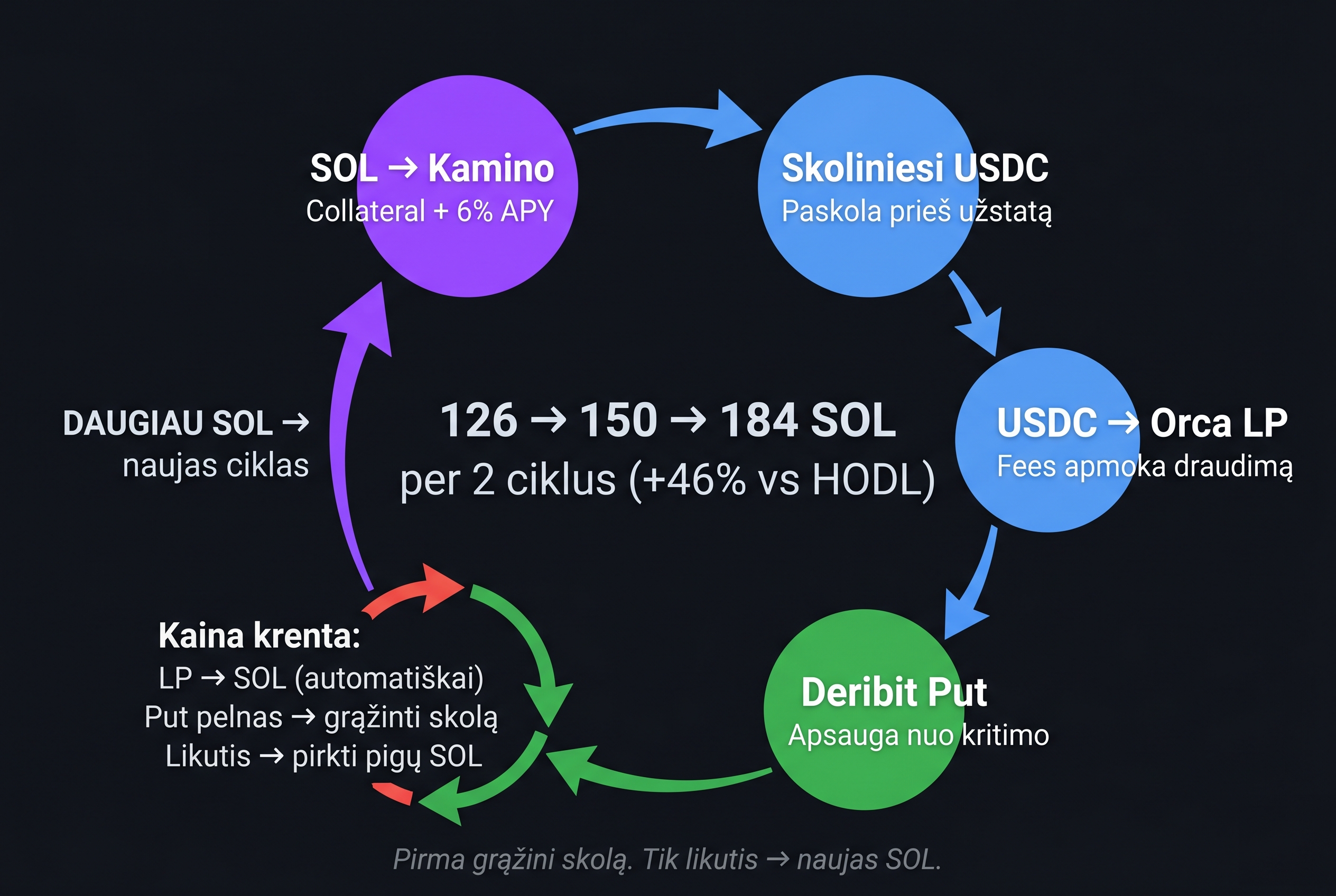
Each layer has its own role in the wheel
Every bear cycle increases your amount of SOLSOLSolana's native token. Used to pay gas and as collateral.Read the lesson →. You don't just "survive" the drop — you profit from it. When the price recovers, your position is bigger than before the drop.
A HODL investor just waits through the drop, because there's nothing else to do. You have a plan ready and turn every drop into more SOLSOLSolana's native token. Used to pay gas and as collateral.Read the lesson → — that's a skill, not luck.
Concrete example: 2 cycles
Cycle 1: SOL $88 → $50 → $88
Start:            126 SOL collateral, debt $4,704 USDC
                  LP: $3,200 USDC (range $64-$88)

SOL falls to $50:
  LP fully converts into SOL (below the $64 lower bound):
    LP → ~42.6 SOL
    (NOT 50! The average fill price is √(64 × 88) = $75.05,
     because a concentrated position buys gradually across the
     whole range, not all at $64. $3,200 / $75.05 = 42.6)
    LP USDC balance = $0

  Put profit: +$2,400 USDC
  This is the ONLY USDC source

  Debt situation:
    Debt: $4,704
    Have: $2,400 USDC (from the Put)
    Short: $2,304

  DECISION: repay $2,400, leave the remaining debt ($2,304)
    LTV with the new SOL amount:
    (126 + 42.6) = 168.6 SOL × $50 = $8,430 collateral
    LTV = $2,304 / ($8,430 × 0.90) = ~30% — safe ✅

Price returns to $88:
  Collateral: 168.6 SOL × $88 = $14,837
  Debt: $2,304
  Repay debt by selling: $2,304 ÷ $88 = ~26 SOL

  Remaining: 168.6 - 26 = ~143 SOL

Gain: +17 SOL (+13%)
When the price is $50, we don't sell SOLSOLSolana's native token. Used to pay gas and as collateral.Read the lesson → to repay the debt — because that would mean selling at the worst possible price. Instead, we leave part of the debt (LTVLTVLoan-to-Value — the ratio of debt to collateral value. LTV 30% is considered safe. LTV 83%+ triggers liquidation.Read the lesson → is still safe at ~30%, against a 75% liquidation threshold for SOLSOLSolana's native token. Used to pay gas and as collateral.Read the lesson → collateral) and wait for the recovery. When the price comes back, we repay then. This is the core rule: never realize a loss at the bottom if LTV allows you to wait.
Cycle 2: SOL $88 → $60 → $120
Start:            143 SOL (more than before!)
                  Debt: ~$5,000 USDC, LP: ~$3,500 USDC

SOL falls to $60:
  LP → SOL:       fully converted (~47 SOL)
                  ($3,500 at an average fill of ~$75)
  Put profit:     +$2,600 USDC
  Repay from Put: $2,600, remaining debt $2,400
  LTV: $2,400 / (190 × $60 × 0.90) = ~23% — safe ✅

Price rises to $120:
  Repay $2,400 debt: $2,400 ÷ $120 = 20 SOL
  Remaining: 190 - 20 = ~170 SOL
  Portfolio value: 170 × $120 = $20,400
Over 2 cycles: from 126 SOL → ~170 SOL, from $11,088 → ~$20,400.
HODL investor: 126 × $120 = $15,120. You: ~$20,400. Difference +35%.
+35% over HODL across 2 cycles is a hypothetical model result, not a promise or a typical outcome. The model assumes every drop recovers; in reality SOLSOLSolana's native token. Used to pay gas and as collateral.Read the lesson → fell to $60 in 2026-06, and −76% from its high over 12 months. The value here isn't the number itself — it's that on every drop you act according to a plan instead of panicking and selling at the bottom. Actual results depend on the market and can be worse.
Sideways market — the wheel still spins
Even when the price doesn't move (±10%), the wheel keeps working:
LP fees:           +$5.95/day
Insurance cost:    -$3.25/day
Debt interest:     -$0.77/day
─────────────────────────────
Net carry:         +$1.93/day = ~$704/year

This carry is the "reward for patience" —
you earn while waiting for the next cycle.
When the wheel stops — and how you manage every stopping point
- SOL never recovers (→ $0) → this is why we only spin the wheel with an asset we believe in long term; you choose a size you could withstand even in the worst case
- Liquidation (the SOL collateral threshold is 75%, during a flash crash) → the PutPutAn option type that grants the right to SELL at a set price. Used as insurance.Read the lesson → $90 protection and the LTVLTVLoan-to-Value — the ratio of debt to collateral value. LTV 30% is considered safe. LTV 83%+ triggers liquidation.Read the lesson → buffer (starting ~42%, liquidation price ~$58 = ~34% of room below $88) buy you time; you track LTVLTVLoan-to-Value — the ratio of debt to collateral value. LTV 30% is considered safe. LTV 83%+ triggers liquidation.Read the lesson → per the 6-4 protocol so you can react in time. The buffer is not theoretical: on 2026-02-05/06 SOLSOLSolana's native token. Used to pay gas and as collateral.Read the lesson → fell 18% in two days and KaminoKaminoSolana lending protocol. In our strategy: SOL collateral to a USDC loan.Read the lesson → saw 55,649 liquidations worth $19.4M
- LP fees too low (below the ~46% breakeven APR) → the 1.48x coverage is monitored regularly (by hand for now; the platform is planned to do it in real time); if it drops below, you move the range or reduce the position instead of waiting out the loss
- Not sticking to the plan (panic) → a weekly checklist and pre-written actions turn the decision into a procedure, not an emotion
Every risk has a solution. You don't fear it — you learn to manage it, which is why the wheel keeps spinning as long as you're the one managing it.
Wheel vs HODL — the final comparison
| HODL | SOL accumulation cycle | |
|---|---|---|
| During Bear | Just wait | Buy cheaper from PutPutAn option type that grants the right to SELL at a set price. Used as insurance.Read the lesson → profit |
| During Sideways | Earn nothing | +$1.93/d carry |
| During Bull | Earn from growth | Earn + hold more SOLSOLSolana's native token. Used to pay gas and as collateral.Read the lesson → |
| After 2 cycles (example) | 126 SOLSOLSolana's native token. Used to pay gas and as collateral.Read the lesson → | ~170 SOL |
| Requires discipline | No | Yes — weekly checklist |
| Requires knowledge | Minimal | This whole school |
Next step: What happens when the market suddenly moves? Crisis management protocols will prepare you for the worst-case scenario.
The biggest beginner mistake is jumping straight to Full. This task is paper-only: a reasoned choice and a few calculations, no real trades (~20 min).
This is learning, not investing — use only small amounts you treat as tuition.
You just grasped how the three layers work together, and chose your level with a breakeven calculation — this is no longer "some strategy you heard about somewhere," but a system you understand down to the last dollar per day.